2019年12月19日星期四

The Best Summer Trail Camera Strategy

The most prominent trail camera strategy in today’s deer-o-sphere is using them to confirm what a hunter already suspects about local whitetails. This is why so many of us mount cameras over standing soybean fields or the edges of food plots in July. We know bucks feed regularly in those spots, and we want to get pictures of them.
It’s pretty simple, really, but often not all that productive. If you’ve got a property locked up and know that no one will come in and mess with the summer patterns, then yes, you can plan a strategy around those images. But be honest, you were going to hunt those spots anyway, because they’re no-brainer locations for early-season bowhunting setups.
The problem with scouting that way is that it works with a good summer destination food source — but then, those patterns crumble just before or right after you get your first chance to slip in with a bow and try to intercept a target buck. This is where trail cameras can hurt us if we’re not careful.
It’s easy to hunt on memory, but a buck that has bailed on his summer food pattern isn’t likely to return to it in a way that will allow you to encounter him during shooting hours. This is especially true if you’re hunting pressured ground, whether public or private.
A better bet with scouting cameras is to use them to figure out what is going on in the places where you’re really not sure what the activity level is, or to sort out the routes target bucks are taking as they travel to/from food sources. Practically speaking, this is what scouting is all about, and it’s possible with the right camera strategy.
The idea obviously is to identify good bucks that might be moving during legal shooting hours, then pin down locations you can sneak into, and actually hunt, correctly. Doing so isn’t nearly as easy as we’d like to believe, though. If it were, success rates would be much, much higher.
Each year I hunt whitetails on public land in four or five states, and if there’s one thing I find consistently, it’s that the easy spots are nearly always worthless to hunt outside the hottest part of the rut. The better bucks I see, and occasionally arrow, almost always have made the mistake of moving during daylight either on a travel route or in a staging area, both of which will be in security cover.
While some big bucks seem to be terribly ensconced in a nocturnal lifestyle, most aren’t. They just don’t move a whole lot during daylight in any place but their favorite sanctuaries. This information matters, because those might be the only spots in which you’ll ever encounter them with enough daylight to get a legal shot.
These spots will almost always relate to a destination food source. That’s true even in the Northwoods, where there isn’t an agricultural field or food plot within miles. The deer usually have a feeding place in mind, but they’ll take their sweet time getting there — and most often, you’ll run out the clock before they poke their nose into any open areas.
So while the soybean field on your farm or parcel of public land is where the bucks will probably end up each night, how they get there and how they leave are what matter most to us hunters. The same goes for the oak ridge in the big woods or an irrigated alfalfa field out west.
four bucks in velvet in nighttime trail cam photo
Staging areas near prime summer food sources are great for velvet buck photos. While much movement by older bucks is at night, even outside open season, photos taken then still can yield solid intel. Photo courtesy of Michael Young.
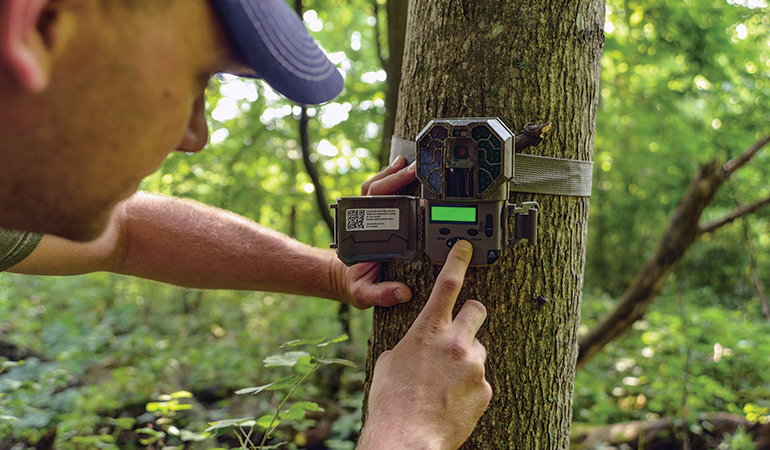
My typical strategy is to start at the most obvious destination food sources and place cameras in the first patch of good cover off them, hanging in what appear to be high-traffic spots. This might be a ditch or ravine crossing or simply a trail carved down the face of a bluff. Regardless, the idea is to get an idea of which deer are moving through the cover near the most obvious food.
It’s important to remember here that the July woods can look a lot different from the September woods, and another thing entirely when you consider November. The first, most likely staging area off the food will last until the leaves drop or hunting pressure on the field edges pushes the deer deeper, or maybe persuades them to stay even farther back.

2019年12月18日星期三

Will Wireless Trail Cameras Make You a Better Hunter?

If you dig into the rules and regulations of your state, you’ll probably see no clear wording on the usage of cellular-enabled cameras. It’s a gray-area technology in most places right now but could be considered illegal if one of your cameras sent you a picture of a buck and you happened to shoot it a few hours later.
In-season usage in many states is up in the air, so be aware. As far as pre-season usage of cellular cameras, you’ve pretty much got the green light in most regions where whitetails reign supreme.
The question is - are they worth the money? Do they really provide an advantage over traditional cameras? The answer is a resounding - maybe.

Benefits of Cellular Cams

The obvious benefit to using a cellular-enabled camera is that once you’ve set it up, you can leave the woods alone. It allows you to sit back in the comfort of your home without wondering if your batteries are still juiced up, if someone has stolen it, or if it inexplicably went the way of the dodo - all while gathering intel in an undisturbed woods.
Throughout the summer you can gather info on the comings and goings of the local ungulates, and with most cameras, adjust your settings and check battery levels remotely. This means you’re aware and in control, without doing much more than messing with your smartphone.
It’s incredible, really. And this wave of cameras is crashing hard on the industry right now - to the point where pretty much every manufacturer is in the game. That tells you something about demand, which if you’ve ever used one, you probably understand.
These cameras are addictive, and it’s exciting to see new-image notifications showing up on your phone. I honestly believe that if any hunter wants to see his day-to-day productivity at work or home go right off of a cliff, cellular-enabled cameras are the way to do it. They are fun - no doubt about that.

Cons Of Cellular Cams

As mentioned above, the biggest downfall of these cameras might be their legality in your given area. If using one means you’re on the wrong side of the law, then it’s obviously no good.
But there is also the ethical conundrum associated with this level of technology. I can remember when they first hit the scene years ago, and a fellow from one of the camera companies told me how he used it during turkey season to check in on what fields had strutting birds in them.
If they hit the 9am lull, they’d go to where the cameras showed longbeards were at right then. He thought it was amazing, I felt differently.
And I still do. I’ve used celullar cameras for deer and bear on properties that were at least a couple hours from my house. My reasoning was that I couldn’t use real-time intel to try to gain an advantage because, at best, I’d be at least 24 hours behind the most current images if I decided to go hunting.
Eventually, they became something of a novelty for me. I put one or two out each summer and then pull them before the season or switch off the cellular function. I still really enjoy getting images from them during the summer and probably always will.

2019年12月17日星期二

Real-Time Intel: Moultrie Mobile

Who says you can't be in two places at once? The right cellular camera system will let you keep tabs on your deer woods even when you're nowhere near.

Until we finally crack the code of Star Trek teleportation, we hunters will have to be content with plodding along between places at standard human speeds. Which is no big deal, normally...but it can be when you’re not in the deer woods but are desperate for information on what’s happening there. Then the need for TV’s 23rd century technology to become reality early in the 21st is a tad frustrating.
Ah, but what if we could be in two widely separated places at once? Or close enough to “at once” that a slight lag was no worry at all? That presumably would make a lot of things in life simpler. And yes, whitetail hunting and management would be among those things.
Well, thanks to the ongoing development of cellular scouting cameras, we now are close to bridging this gap. We can in effect be in the deer woods even when we aren’t.
We’ve had stand-alone scouting cameras for over two decades now, and they’re popular. But today’s growing interest in the use of cellular-enabled cameras has sprung from four realities: (1) It takes time and often a fair bit of fuel and effort to physically check any camera; (2) every time you visit a camera site, you risk spooking deer — thus offsetting some of the practical advantage offered by acquiring photos of them in the first place; (3) by the time a camera has physically been checked, even the most recent capture image is likely to be somewhat dated; and (4) if you have trespasser/thief issues, a cellular camera offers better odds of identifying the perpetrator. Add up these facts and it’s easy to see the advantage of being able to monitor a spot in real time, even when you’re not around.
 

trail camera photo of nursing fawn
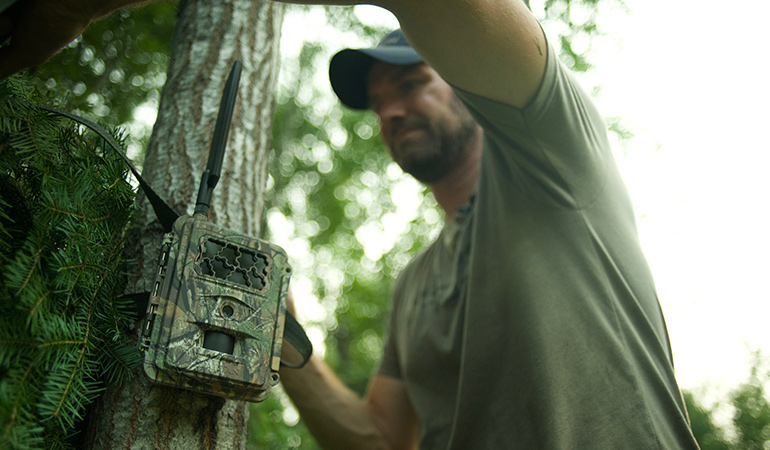
The newest approach to doing so comes from the folks at Moultrie. Their app-based cellular camera system - Moultrie Mobile - allows for quick, easy, affordable and disturbance-free camera monitoring, as well as handy storage/retrieval of captured images.
 

Over the past few weeks I’ve been putting this system through its paces, and it’s performed as advertised. The unit I’ve been using is the XA7000i, which is built around a 20MP camera.

The camouflaged camera and its neutral-tone strap are really hard to see on most trees, which is great. Not only is the camera well hidden from human eyes, I’ve captured no images of deer looking at it during the day or at night. The invisible flash (80-foot range) thus seems to be undetectable by deer. All these attributes are key advantages, in my book.
Of course, stealth doesn’t much matter if the camera won’t reliably capture images. But this one has done so for me. Using the 7000i in a spot that has a fair bit of daytime and nighttime deer activity, I’ve found it captures clear images and lets you see them within only a few minutes of the event.
Easily controlled via a free app on a smartphone - and with extremely affordable service and storage plans - this system seems a solid option for anyone wanting to enter the cellular camera game without first getting an engineering degree. And that’s helpful. Hunting, management and/or security concerns have many folks wanting a better connection to the deer woods. If you find yourself in that situation, give the Moultrie Mobile XA7000i a look. It could open your eyes to more of what’s out there when you’re not — and let you know about it in close to real time.
 

2019年12月16日星期一

The Science Behind a Deer's Sense of Smell & Scent Control

Understanding the science of a whitetail's scenting ability might not guarantee you a filled tag, but it definitely can't hurt.

On a brisk November morning in 2008, as I was running the video camera for my friend Chris Ellington in Clark Co., Illinois, we spotted a fat-bodied buck cruising up the ridge about 100 yards to our east. The chilly west wind was dragging our scent perpendicular to the buck’s line of travel, and we could tell the two were about to intersect.
”This ain’t gonna be good,” Chris hissed.
The big buck’s body language screamed “lovestruck zombie.” His mouth was open, his nose was almost on the ground, and he was doing the classic doe-seeking speed walk. In short, he was all but oblivious to his surroundings.
But when the buck hit our wind cone, his reaction was instantaneous. As if human scent had hit him in the face like an invisible baseball bat, the buck’s careless, rut-induced autopilot mode disappeared. He stopped in his tracks so quickly that his skin and fat shuddered.

The buck whipped his head, swinging his chocolate rack around in a whirl, and looked across the ravine directly at us. His black eyes were wide with alarm. It took all of about five seconds for him to take that first half-step backwards and then bail off the ravine away from us, blowing and flagging.
This episode was an example of how quickly a buck’s demeanor can change when human scent is intercepted. We all know whitetails possess excellent olfactory ability, and this buck offered but one example of it in action. Let’s examine the whitetail’s superpower sense of smell a little more deeply.

Defining Scent

So, what is scent? The answer gets a bit technical, but understanding scent and its origin is critical. After all, how can we as hunters attempt to control or eliminate scent if we don’t understand it on a biochemical level?
Biologist Dr. Bronson Strickland of Mississippi State University’s Deer Lab describes “scent” as a generic term for what’s known to chemists and wildlife researchers as volatile organic compounds (VOCs). He explains these substances originate as organic compounds given off by a subject. Due to their high vapor pressure, these lead to large numbers of molecules evaporating into the surrounding air.
VOCs entering the air can come from numerous sources. Manmade products such as gasoline, diesel fuel, paints, oil, tar and perfumes all give off unique VOC signatures. Plants give off their own VOCs when leafing, pollinating, flowering and growing. These signatures change throughout their annual growth cycle.

Our bodies give off literally thousands of VOCs. The human liver, kidneys, lungs and skin are all tasked with taking toxins from normal metabolism and rendering them chemically removable from our system through excretory pathways found in feces, urine, breath, sweat and saliva.
In one study, more than 1,800 distinct VOCs were determined to come from our body! Breath (872), skin and hair (532), feces (381), saliva (359), milk (256) and blood (154) made up the list, with some overlap among the compounds. Bacteria also give off their own unique VOC signatures on our body and clothes.
The take-home message is simple here: Normal body processes make us like a lightning rod projecting scent into the air in the form of VOCs. To put it frankly, we stink!

The Olfactory Pathway

Now that we’ve defined scent in its true chemical form, let’s climb into a VOC molecule and take a ride through a whitetail’s nose. Hold on tight.
A scent molecule is inhaled through the broad nasal openings and captured by little hair-like cellular projections called cilia in the mucous membrane. Once captured by the cilia, VOC molecules dissolve into and through the mucous and are transferred to the olfactory epithelium. Note: The whitetail epithelium is reported to have 297 million olfactory receptors. (The human epithelium has only 5 million.) These receptors translate the scent signal as electrical impulses up through nerves that extend through the roof of the mouth and into the part of the brain known as the olfactory bulb.

2019年12月14日星期六

Hunting Waterfowl from a Kayak

Find a slow-moving stream and paddle to your own duck and goose paradise.

Like Huckleberry Finn, I’m a child of the river. Nothing gets me out of my chair and up and going like a trip on a stream. Being a Senior Sportsman can make me think twice about certain activities in the outdoors. I can’t slog through a muddy plowed field like I used to, but I’ll still go if the geese are flying.
But the river has a pull on this old Huckleberry. There’s nothing like riding the current, especially in the fall. Especially when the wood ducks are migrating. Nothing like it.
Imagine those beautiful leaves falling and you drifting quietly downstream. Think of rounding a bend in the river and having a flock of Canadas blast off from the shoreline right in front of you. Can you see it? Would you be able to make the shot in your excitement ? Or would you swamp the boat and have to clamber out in the cold and get a fire going real quick?
Either way, the river is always an adventure. Either way, you will leave the river at the end of your run already planning your next float trip.

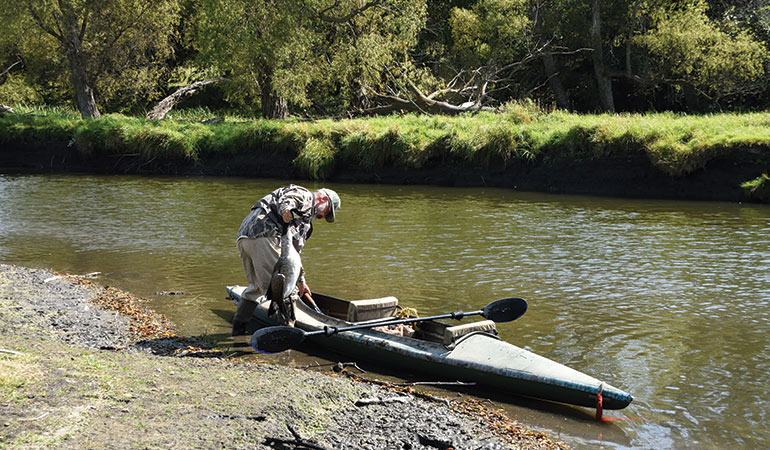
These days folks are really starting to get into kayaks. Kayaks are becoming popular in the fishing community. Here on the river, we think kayaks are a big deal too. Back in the day, we float hunted on the river using canoes. Not anymore. Kayaks put you down lower on the water and that lowers your center of gravity. You are much more stable shooting out of a kayak. I used to be afraid of rolling my canoe with a shot to the side. Not with my kayak.

 How does a float hunt on the river work? Well the first thing about it that may surprise you is that this hunt begins at 10 o’clock in the morning. Nope, no sunrise vigil like on the slough. If you do go early you won’t find many geese. They fly out at dawn to feed just as they do on the slough. Then at around eight or nine they return to the river to hide and loaf. That’s why we start our float at 10. Bankers’ hours. So let’s try a simulated float hunt and see if you’d like it.
What’s a river float for waterfowl like? I’ve been asked that question a lot. Well, maybe I can explain it this way: You drift quietly down the river with every sense alert. You round a bend and there’s a flock of birds loafing on a sandbar ahead of you. They’re too far away so you hold really still and the current takes you slowly, slowly toward them.
Now actually, that’s the way I like to explain it. That’s the best time of the hunt, the tension and anticipation. The possibility of a big shoot ahead. You’re close enough to make your move now and you pull up on an exploding flock. But the kayak has drifted to the left and you’re a right-handed shooter. So you track a bird and realize you’ll be lucky to get one bird when you expected to get off three shots.

NO CAKEWALK

But honestly, you won’t be surprised. A float hunt on the river is never easy. Too many things can/do go wrong. Wind, for instance. It’s your friend when it gets the trees to rattle their leaves. You don’t make noise with the wind blowing. But then, you run into a flock of birds and you have to freeze or the birds will beat you. So the wind is blowing you at them and manages to turn the kayak completely around before you’re in range. Who’s your friend now? It happens.
Much of a float hunt ain’t good. Imagine sitting on a moving platform, shooting at a moving target. That’s what we laughingly call a humbling experience. Yes, you’re thinking that you’re a reasonably capable shooter. Then you ride the river with us. We put you in the front seat of a twin-seater kayak. Nothing to do but shoot. Plus, if we come upon that flock on the sandbar, I’ll paddle you right up there.

NATURE WONDER-CRUISE

The best part of a float is that most animals and birds that we encounter are sleeping or very relaxed so we get a good up close look at them. My son Will’s Nikon is cranking when we run by a big turtle. He loves mossy- backs with the big claws. He caught beavers asleep on their lodge last year. Fun-fun-fun!
goose hunter getting out of kayak
We live in Minnesota. Out on the western prairies we have reminders of the French traders that named our rivers and the big lake Lac qui Parle. Out here we pick our float hunt rivers with care. That’s the best advice I could give to a waterfowler who wants to try a float hunt. Will and I had to learn that lesson the hard way. We thought the faster the river the better. We’d get up on them quicker. We not only got up on the birds quicker, we also got swept into snags that were under water and limbs low on the water to roll us.
Will lost a nice Nikon and lens that way and he shot downstream backwards, fending off rocks with his feet. Then we still had to pull the kayak out and continue to our take-out spot. All in all, a lesson learned. As the old song goes, “up a lazy river we go,” and since then, we have had far less trouble targeting slower waters. And yes, we take every precaution. We wear flotation vests, but those without big pads over the shoulder. That way I can shoot better and swim better too, should the need arise.
If you’ve noticed, kayaks are a big deal with anglers lately, and it made a big change for us, more stable giving you a lower profile for birds watching out for hunters. They also have nice covered areas fore and aft to keep duffle dry. Two of the best makers of hunting kayaks are Old Town and Poke Boat. Will has a camo pattern that he paints on both boat and paddles.
That’s all part of the attention to detail that we put into these festivities. Camo clothes with a change along in case of dunking. Camo gloves on the hands and a face mask for camo and sunblock. We’ve even been known to attach branches to the front if the birds are super wary. Now I’ve even purchased a camo 10-gauge from Browning. My old Ithaca Mag 10 jammed one time too many.
Why the big gun? Because it knocks down geese at a distance and ducks too. Wise ducks sit at the bend of the river. When you come around a corner upriver, they jump and just have a foot or two to fly before they are gone around the next corner. With a 10, I can sometimes reach out at long distances before they’re gone. Also, even if they jump close I have more time to shoot when I can reach out further.

GO WITH THE FLOW

These are true Huck Finn experience hunts for us if we get the time. Lazing down the river, shooting a few ducks along the way. Pulling up on a sandbar and dressing out a couple. Spitting them over a bed of coals with a tin can of coffee in hand to savor while waiting for the meat to get done. If possible, and when would it be not, a bottle of merlot to enjoy with our duck. I like a good cigar about this time to celebrate the hunt. Then the gun is put away while we put our dishes away and paddle for the takeout.
Each fall we go on the river and follow the migration. It begins early with the “summer ducks.” Woodies and teal that sit in trees and blast off branches that are over your head and weave through trees. That’s the wood duck, but teal will rocket away so fast you won’t believe it. As the migration moves along the flocks will build until a hard frost drives them south. But you won’t mind.
Because next come the fat mallards from Canada. These beauties can’t rival a woody for color, but they are much easier to hit.
They jump straight up off the water and don’t swerve as much in flight. Woodies not only fly in and out of trees, but they often fly low on the water making them hard to see when the sun sparkles the waves on the river.
Wood ducks have a nutty taste and teal are so succulent, but mallards are hard to beat for flavor too, and they stick around on the river until the water freezes over.
Other ducks like ringbills and goldeneyes are there on the cold days and we are too. Chopper mitts on hands and electric boot heaters help a lot, but a little suffering is necessary at that time. It will be worth it and all the sweeter when you know it will soon be over for the year.
By far, my favorite quarry on the river is the big Canada goose.
The geese come to the river to escape detection. Once they are down on the river they aren’t going to be found too easily. They only have one problem. They need openings in the trees along the river in order to land. With that in mind, you’ll kind of get an idea of where to expect them. That and the fact that they love to make those honks and nuk-nukks that warn you that they are around the next bend. Talk about excitement. A dozen geese sitting on a sandy beach means you’ve punched your ticket for some real waterfowl hunting fun. Another reason for my beloved 10-gauge.
A goose has to jump and fly into the wind to get airborne. They aren’t hard to hit when they do that, but you need to hit them with a heavy load to bring them down. Again, the 10-gauge. And as with any bird you bring down on the river, you have to finish it on the water unless it’s dead. A crippled duck or goose will do remarkable things to hide or escape. They will swim into snags that you can’t get them out of. They will swim to the shore and scurry into the brush where you can’t get them without a dog.

POCKET RETRIEVER

And speaking of dogs. My family came to the prairies of Minnesota from Wisconsin, and brought their dogs with them. The little American water spaniel has fallen out of favor in these days of the ubiquitous Lab, but our family never forgot. A river float is what these little retrievers were bred for. At forty pounds I can pick her up and plop her in the back with ease. Drop a duck in heavy cover along the shore? My baby will find it. In heavy current she can use her tail as a rudder. Very fun to watch.
And before you think rivers are the only game in town, consider a paddle through a slough or along the lakeshore. The advantage of a quiet approach is still yours on a slough or lake. Besides our diminutive retriever, we’ve found lightweight blow up decoys by Cherokee Sports Decoys. They take up very little room and weigh next to nothing. Find a spot, and wait for the action.
I know from experience that you will find it daunting to learn to shoot from a sitting position, but with practice you will improve. I put the kayak on the ground and sit in it while a friend launches clays with a hand trap. It is a learning curve but if you want to ride the river or creep through a slough or some brushy lakeside, you’ll have to learn.
I don’t like to get up early in the morning. I don’t like to wait around by the decoys if I don’t have to. A river float is more like a pheasant hunt. You’re moving along seeing lots of new country. Jump shooting woodies is much like shooting flushed pheasants and to me, that’s great fun. You won’t see a lot of people and now that I’ve explained how frustrating the shooting can be you know why more people don’t do it.
But even though it’s tough shooting, Will and I will be there, for we know a secret: Disneyland for duck men is a lazy river.

2019年12月13日星期五

High-Tech Duck Scouting

Find your next waterfowl hunting hotspot with your smartphone

When I'm not following a black Lab around, I spend an awful lot of my time bowhunting public-land for whitetails and other critters. This, as you can imagine, requires a lot of scouting. Long before I had kids, this meant that I'd slip on a pair of knee-highs and start covering ground.
These days, my time is far more limited. That means it's necessary to use whatever tools are available to find hunting hotspots without having to devote hours to hiking randomly across the landscape. In the deer world, this is no secret and is a popular way to get a good idea of what the woods offers in the form of ambush sites. For waterfowlers, it seems as if high-tech scouting hasn't caught on as much.
Part of this is due to the fact that many of us have our near-and-dear spots, which play into our hunting traditions and preferences. I get that, and I've got a few blinds that feel like home. But I also love to find new places to hunt, especially close-to-home gems I might not have realized existed without a little research. These spots are my back-ups, or simply become the places I'll go to in order to get a wood-duck fix for an hour or two before it's time to get into the office.

Scouting waterfowl spots via satellite imagery is a way to get on some ducks that might not be on your radar.

Of course, with the right research you might find a new area that will be something truly special. Last fall, a good buddy of mine found one of these spots in north-central Wisconsin. At some point, likely half of a decade or more ago, someone dug out a good-sized, L-shaped pond in their woods. It's a wood duck and mallard magnet, and I have no doubt that for years it was off limits to the public. Today, it's in a tax-advantage program that allows for public hunting.
The pond isn't visible from a road, requires enough of a hike to dissuade most weekend warriors, and looks like an awful lot of the water in the county. But it's got something that the ducks like, and it's a rare day that you can sit there at sunrise and not take the safety off several times.
While Google Earth was the first truly accessible public program, there are several available now that offer sportsmen more. A personal favorite is onX maps. Their Elite membership allows you to pick five states and peruse high-quality aerial photography at your leisure.
They also offer overlays of landowners, and provide easy identification of public land. This matters — a lot. If you're looking for a way to access a backwater slough, or see an oxbow lake that looks too good to be true, you can figure out who owns it or if there is public access. Keep in mind that on a state-by-state basis, the legality of access into navigable water varies a lot. Know the laws before you start looking for potential hotspots so that you understand at the onset whether your findings are worthy of the next step.

Get In And Look

When I find intriguing waterholes tucked into publicly accessible spots, I mark them on my aerial photography and then get ready to take a hike. There is a disconnect between a beyond-the-clouds satellite view and what you'll actually see in person. Some spots look dreamy on your computer, but in person they are marshy messes that are unapproachable and unhuntable.


After using satellite imagery to find potential waterfowl hotspots, slip in and take a look around. Generally, if you see ducks now, you'll see ducks when the season is open.
Get in and really look. I carry binoculars and biodegradable flagging tape or reflective tacks so I can find my way back in, should I deem the spot worthy of a morning or two. The binoculars are for some long-range observation. Oftentimes, if a waterhole is worth it, there will be ducks or geese there throughout the summer. Plus, with binos I can take a cursory look at a place and decide if it's worth getting in for a closer look.
If you do find a place that gets your spidey senses tingling, make sure you figure out the best way to hunt it. Some of my best spots consist of a point of poplars poking out toward a half-acre cattail swamp in the middle of hundreds of acres of public land. Others are simply wide creek bends, or a patch of higher ground in a slough. Make sure you do more than identify a good location, but also locate the best spot in which to hunt it. That summertime work, complete with the heat and the bugs, will not seem worth it in July. In October or November, it will be invaluable.

Conclusion

Borrow a page from the public-land bowhunter's playbook and use satellite imagery to find your next duck hotspot. It'll take some time perusing the internet on your smartphone to find some potential honey-holes and then some boots-on-the-ground work, but once you get a great spot squared away, it'll all be worth it.

2019年12月12日星期四

Hunting Land: Why You Should Invest

Access to private land was getting tougher, leases getting more expensive and public hunting areas were getting crazier, so Brett Kik did what a growing number of hunters are doing these days: He plunked down a big chunk of money on a 160-acre tract of western Kentucky hunting land for sale. It wasn't much of a duck hunting property, at least not at first, but after making some improvements, it ended up being a pretty decent spot.
He's not alone. It seems everywhere you go, our public lands are more crowded than ever, and knocking on doors for permission gets tougher with each passing year. Buying a piece of hunting land is turning out to be the best option if you can swing it.
The advantages are obvious, says Kik, a 46-year-old highway contractor from Madisonville, Kentucky. It's yours. No one will outbid you for the lease. The landowner's family won't decide they want to hunt your blind, and you are free to do whatever you want.
You can build on it, cut trees, plant trees, develop a seasonal wetland and plant food plots. You can even sell it if you want, something Kik has done on several occasions since he bought that first tract in 1994. In fact, he's actually made a tidy profit on several properties he improved. Flipping isn't just for houses.
"We've built levees and installed a pump system to create a green timber spot, we've created wetlands where there were none and planted crops and native vegetation to attract birds. We bought one property and improved it and now we lease it to a group of six guys," he says.
"We bought another property, improved it and turned around and sold it for a real nice profit."
Setting Limits
Of course, hunting land for sale, even swampland, isn't cheap these days. The demand for recreational property is driving up prices in areas where few people would have considered buying duck hunting land a decade ago.
Kik bought his first property only after he cashed out his savings account and stocks, a risky move but something he doesn't regret. Since then, he's bought a half-dozen properties. Some have had fantastic duck hunting; others only marginal.
"You need to be realistic. Don't expect limits every time you hunt. You might get that at a $5 million duck club, but a 50-acre swamp might be hit-or-miss, depending on the time of year, the weather and other factors," says Kik.
Hunting land is somewhat cheaper where he likes to buy property. It can be considerably more expensive in the better-known and more popular duck hunting destinations. Prime green timber around Stuttgart, Arkansas, for example, is selling for upwards of $6,000 an acre, says Mossy Oak Properties broker Jeramy Stephens. Rice fields cost about $4,000 an acre and even untillable swampland is going for $2,000 an acre.
But, you don't have to buy a multi-million dollar duck club to have a great spot to hunt. Nor do you have to buy in the middle of world-famous duck country. There are lots of other places that have equally good duck hunting  land, if you can afford them.
Waterfowl Properties, a spin-off of Whitetail Properties, has a 339-acre parcel with over two miles of Mississippi River frontage in west-central Illinois for $425,000. They haves maller parcels with wetlands listed for as little as $100,000. Something as small as five acres with a beaver pond on it in a state with marginal duck hunting can still attract good numbers of birds if managed properly.
But Are There Ducks?
Hunting_land_for_sale_4
The mere presence of water does not mean mallards will be pitching into the decoyscome fall. This is where thorough vetting comes into the equation. It helps to hire a real estate agent who not only knows the recreational market, but who also knows ducks, duck hunting and the local waterfowl scene, because even land in great areas can offer marginal hunting.
For example, you can buy property that sits between two of the best duck spots on the river, thinking it's a can't-miss purchase. Only to find out, the two clubs have more resources and better habitat, so you're shooting maybe a third of the birds they do.
Remember, the presence of blinds and food sources are good signs, but for a real glimpse at the potential look at properties during the season. Scout it as much as you possibly can. Ask local biologists and other hunters to get a general idea of what to expect.
"Some clubs keep detailed records of their harvest, which can be a big help," says Stephens. "Most people who own smaller properties don't keep track of those things, though."
Year-Round Commitment
If you can afford land and it holds a good number of birds during the season, you'll still be making monthly payments all year, even when there isn't a duck for a thousand miles. That's OK with Kik, though. His properties aren't just places to spend a Saturday in November and December. He's doing something, even if it's just relaxing, at one of his properties all year.
"I tell people if they aren't willing to put in the effort necessary to improve and maintain the land, then don't buy property," says Kik. "If all you want it for is to hunt ducks, go on a bunch of guided hunts. You'll actually save money. Buying hunting land isn't cheap and neither is improving it and maintaining it."
That's one mistake Stephens sees with first-time buyers. They acquire a piece of property without realizing that even swampland needs to be maintained. Levees can break or leak, pumps need regular maintenance, roads and trails need to be kept up and some properties need to be planted with crops to attract birds. All these activities are expensive and time-consuming.
Part of the joy of owning property is putting sweat equity into it. Planting food plots, creating impoundments, even building a small cabin is as rewarding to many hunters as shooting a limit of greenheads. It's what they love to do.
It's how they spend every free moment and every spare cent. Fixing up property is truly a labor of love that is rewarded when duck season rolls around.
"I would recommend buying something relatively close to your home so you don't spend hours just driving to the property. You want to be able to spend just a few hours there if that's all you have time for," adds Kik.
Make It Pay
Purchasing hunting land is costly, but there are some things you can do to recoup at least some of the expense. Kik has sold the timber off some of the land he bought and placed others in a conservation easement, including the wetland reserve easement program (WRP), administered by the Natural Resources Conservation Service.
Under the new program, landowners can receive technical assistance and cost-share funding to restore wetlands. Stephens has seen payments as high as $2,400 per acre for irrigated cropland and about $740 for forested land. The one-time payment won't likely pay the mortgage, but it will help.
"Putting land into WRP places a number of restrictions on the land, so it may not be the right choice for you," says Stephens.
That's assuming the land even qualifies. Typically, NRCS agents will visit the site and determine if it is eligible. It's a lengthy process and there's no guarantee you'll see any money, even if you do qualify.
A WRP contract typically does not allow crops, but you can recoup some costs if part of the land is farmed. Many new landowners simply lease the farming rights to a local farmer, often the previous owner. Lease rates vary dramatically, but if nothing else, the money will help offset monthly payments and the routine expenses that come with owning property.